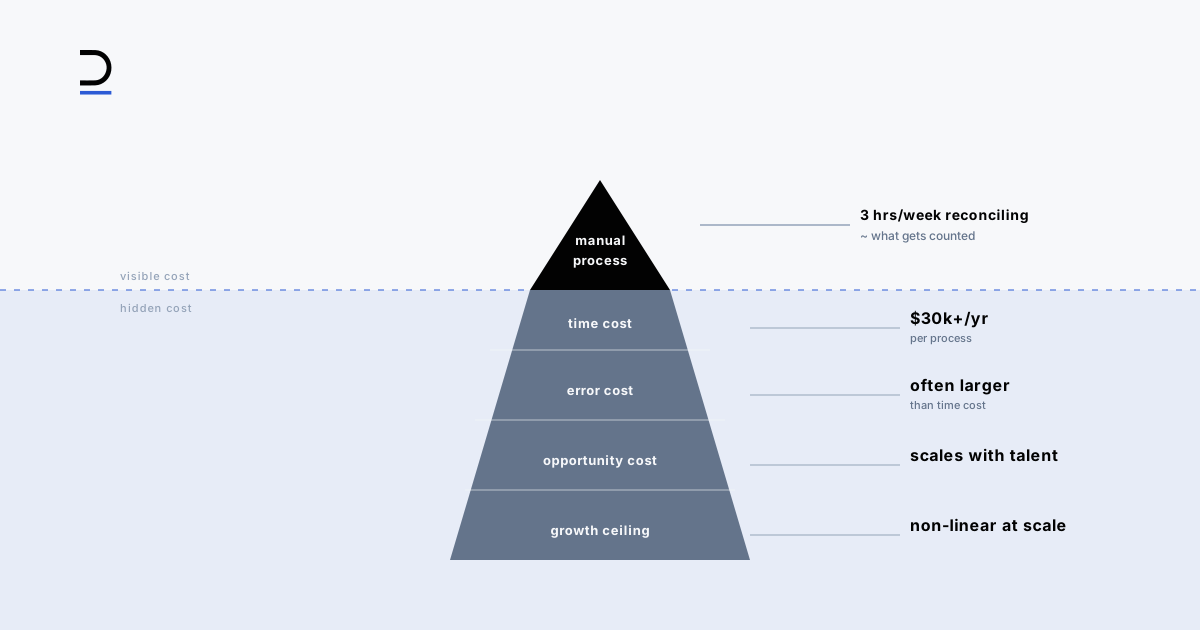
The real cost of running your business on manual processes
There's a reason most businesses underestimate the cost of their manual processes: the costs are hidden. Nobody gets an invoice for the three hours a week your operations manager spends reconciling spreadsheets. Nobody bills you for the errors your data entry produces, or the decisions that don't get made because the information wasn't available in time.
These costs are real. They compound. And they're almost always significantly larger than the investment required to eliminate them.
Here's how to calculate what your current processes are actually costing you.
The time cost
Start with the simple version: who does this task, how long does it take, and how often?
A manual reporting process that takes four hours per week across two staff members costs roughly 400 hours per year. At a fully-loaded cost of $75 per hour, that's $30,000 annually — for one process.
Most businesses have between five and fifteen of these processes. The cumulative number is usually surprising.
The error cost
Manual processes produce errors. That's not a criticism — it's a property of systems that depend on human attention and consistency applied to repetitive tasks. The question is what those errors cost.
Error costs come in several forms: time spent finding and correcting mistakes, decisions made on incorrect data, compliance failures and their associated penalties, and customer or partner friction when errors are visible externally.
The error cost is harder to calculate than the time cost, but it's often larger. A single incorrect invoice that triggers a payment dispute can cost more in staff time than a month of the original manual process.
The opportunity cost
This is the cost nobody puts in the spreadsheet: what could the people doing these tasks be doing instead?
Your operations manager reconciling spreadsheets for three hours every week is not analysing patterns in your operational data, improving your processes, or developing the institutional knowledge that makes your business better over time. They're doing data entry.
The opportunity cost of manual processes scales with the quality of the people doing them. The higher the calibre of the person, the more expensive it is to have them on low-value tasks.
The growth ceiling
Manual processes don't scale. A process that takes four hours at current volume often takes twelve at double volume — because the complexity of the task grows non-linearly with the data volume.
This creates a growth ceiling. Businesses that want to grow have to choose between hiring to accommodate the manual overhead (expensive and fragile) or automating (a one-time investment that scales).
Many businesses hit this ceiling and mistake it for a hiring problem. It's an automation problem.
Calculating the ROI of automation
Take the annual time cost, add a conservative estimate of the error cost, and factor in the growth trajectory. For most businesses running significant manual processes, the ROI of automation is between one and three years — with the savings compounding every year thereafter.
The businesses that automate early don't just save money. They make their people's work better, their decisions faster, and their growth less constrained.
The question isn't whether automation is worth it. For most manual processes, the numbers aren't close. The question is which process to start with — and that's where a practical assessment of your operations, rather than a theoretical one, makes all the difference.