How to assess AI readiness for your business
The most common question we get from businesses exploring AI is some variation of: "Where do we start?" It's the right question, but it's usually asked too late — after someone has already bought a tool, hired a consultant, or started a project that isn't going anywhere.
The honest answer is that you start by assessing whether you're actually ready. Not in a theoretical sense, but in a practical one. AI readiness isn't about attitude or ambition. It's about whether the conditions exist for AI to produce a useful outcome.
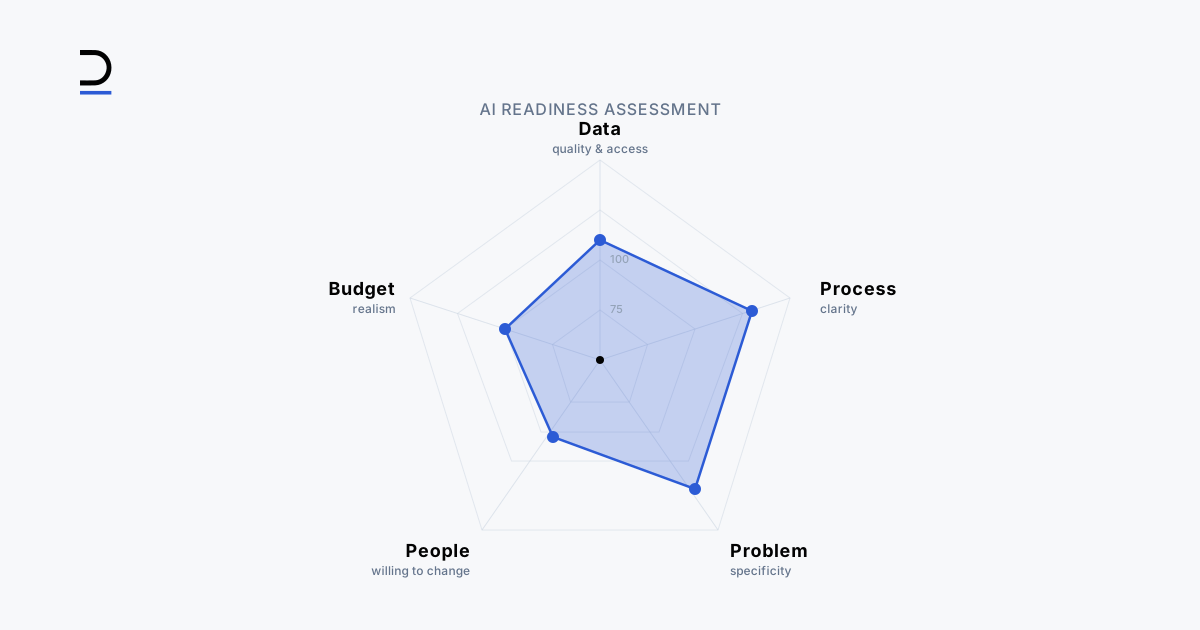
Here's the framework we use before starting any engagement.
1. Data quality and availability
AI systems are only as good as the data they operate on. Before thinking about what AI can do for your business, you need to honestly answer: what data do you have, where does it live, and is it clean?
Common red flags: data scattered across spreadsheets and disconnected systems, no consistent identifiers across datasets, manual data entry with no validation, and significant gaps or inconsistencies in historical records.
None of these are disqualifying — we've worked with businesses that had all of them. But they add scope to any AI project, and pretending they don't exist is how projects go over budget and under-deliver.
2. Process clarity
AI can automate processes. It can't automate chaos. If the process you want to improve isn't clearly defined — if it runs differently depending on who's doing it, or if the steps aren't documented anywhere — then AI isn't your first problem.
The businesses that get the most out of AI are the ones that have already done the hard work of understanding their own processes. AI then accelerates and scales what already works.
3. A specific problem, not a general desire
"We want to use AI" is not a problem statement. "Our customer onboarding process takes 14 days because of manual document verification, and we're losing 20% of leads during that window" is a problem statement.
The specificity matters because it determines whether AI is actually the right solution. Sometimes it is. Sometimes the better answer is process redesign. Sometimes it's a simpler automation. We'd rather tell you that upfront than charge you for something you don't need.
4. Organisational willingness to change
This is the one nobody talks about. The technical side of AI implementation is almost never the hard part. The hard part is getting people to change how they work.
AI projects fail when they're imposed on teams rather than built with them. When the people who will use the system aren't involved in defining what it should do. When "adoption" is an afterthought rather than part of the design.
Before starting any AI project, we ask: who will use this, and do they want it? The answer shapes everything.
5. Budget and timeline realism
AI-assisted development has made custom software significantly more affordable than it was five years ago. But it still costs money and takes time. The businesses that struggle are the ones with unrealistic expectations on either dimension.
A useful AI system for a business process — built properly, integrated with your existing systems, tested against real data — takes weeks, not days. And it costs thousands, not hundreds.
If those numbers sound wrong, it's worth having an honest conversation before anyone starts writing code.
Readiness isn't binary. Most businesses are ready for some things and not others. The point of this assessment isn't to find reasons to say no — it's to find the right starting point. The highest-value opportunity that's achievable with what you have right now.
That's always a better place to begin than wherever the hype says you should.