From domain expertise to software product: a builder's roadmap
Quick answer: The path from domain expertise to paying customers is a five-phase journey: validate the problem, analyse it in detail, design the solution, build with the right technical partner, and plan for the run from day one. The hardest parts aren't the technical build; they're the validation upfront and the run phase afterward. Most founders underestimate both.
If you're a lawyer, consultant, engineer, accountant, or any other kind of subject-matter expert, there's a good chance you've spent the last few years thinking about a software product. The idea is grounded in a real problem you've watched up close, sometimes for decades. The pain is genuine. The market exists. The frustrating bit has always been that you couldn't build it yourself, and the cost of paying someone else to build it was so high that the maths never quite worked.
That's changed. AI-assisted development has dropped the cost and time of building software meaningfully in 2026. The maths now works for a lot of ideas that didn't pencil out 18 months ago. So a lot of domain-expert founders are starting builds.
The lower build cost is good news. It's also a trap. It's now easy to start building too quickly, before the idea has been tested or properly thought through, and end up six months later with a product that works technically but doesn't have customers. Here's the five-phase roadmap we'd suggest, drawn from the founder builds we've watched (and the mistakes we've made on our own products).
Why do most non-technical founder software builds end badly?
The pattern we see most often goes like this. A subject-matter expert has been thinking about a software idea for years. They've discussed it with friends and a few clients. They have strong intuitions about what's needed. They engage a developer, hand over a list of features, and wait for the result. Six to nine months later, the software exists. It works. But the customers they assumed would be desperate for it aren't ready to pay, or are ready to pay but only for something different, or have already started building their own version internally.
The technology was the easy part. The hard parts were the ones that came before and after the build, and the founder underestimated both.
It's not that the founder lacked expertise. They had more domain expertise than anyone they could have hired. The mismatch was that domain expertise tells you what the product should be in principle. It doesn't tell you what version of it people will actually buy, in what shape, at what price, with what support. And it doesn't tell you what running the software once it exists will cost in time, money, and operational attention.
This is why the path from idea to paying customers is staged. Each phase produces information you need before the next phase makes sense.
What are the five phases of building a software product as a non-technical founder?
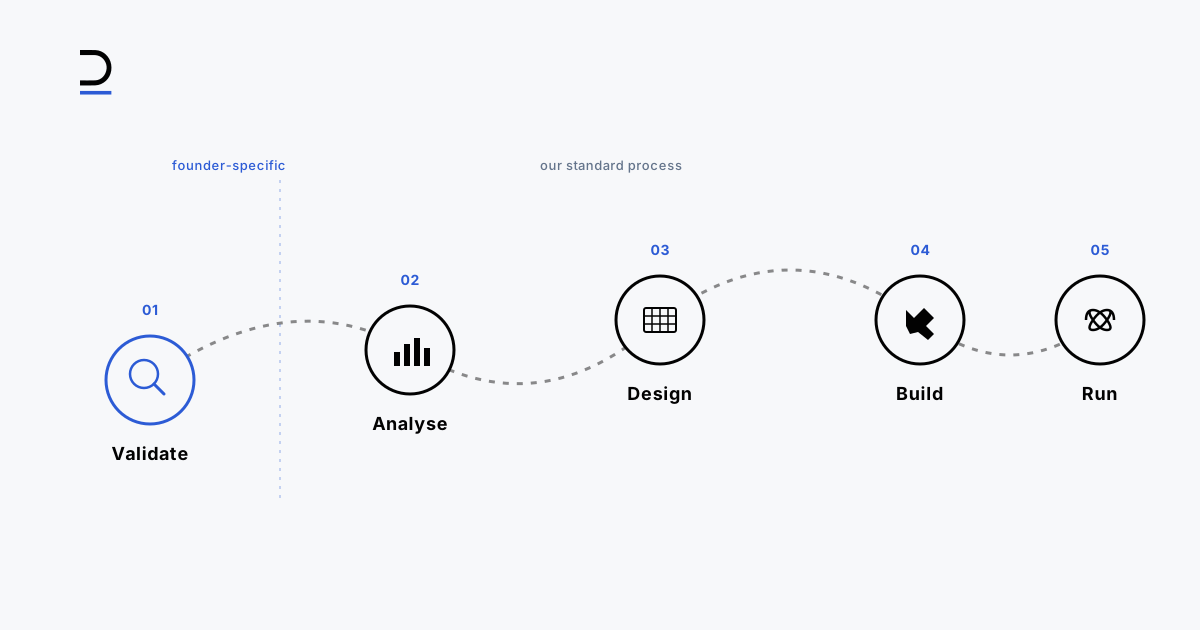
The roadmap below mirrors the four-phase process we use on most software builds (Analyse, Design, Build, Run), with one extra phase added at the front for founders specifically. Founders carry an extra question that established businesses don't: they don't know yet whether the idea is valid. So the journey starts with Validate.
1. Validate.
Before committing to a build, test the idea. Talk to people who would buy it. Look for the language they use to describe the pain, not the language you use. Test willingness to pay through paid pilots, deposits, or letters of intent rather than by asking "would you buy this?" (the answers to which are useless).
Validation is harder than it sounds, and we should be honest about that. We've made the mistake of skipping or under-investing in this phase several times on our own products. It takes immense effort, the signal you get back is usually weaker than you'd like, and at some point you have to act on incomplete information anyway. Founders also need conviction. If you waited for perfect validation, you'd never build anything.
So the practical advice is more nuanced than "validate before you build". Validate as much as you can before you commit serious money. Keep validating as you build. And accept that some of validation only happens once real software is in the hands of real users. The mistake to avoid is treating validation as optional rather than as a thing you balance against momentum.
The case study we'll use through the rest of this article is a corporate integrity expert we've been working with on an AI-driven workforce-complaints platform. He spent over a year talking to potential customers, building paid pilots, and refining what the product actually needed to do before software construction began. That validation work is the reason the platform now has design clarity that most founder builds never reach.
2. Analyse.
Once the idea has enough validation behind it to commit, the next phase is to analyse the problem the software will solve in detail. Not "what features should it have", but "what is the operational pattern this software is replacing or augmenting, and what does success look like in concrete terms". This is the phase where the founder's expertise is most valuable and most often under-used.
In our integrity expert's case, the analysis phase mapped the existing workflow for handling workforce complaints across several types of business: who's involved, what gets recorded where, what regulatory requirements apply, where the bottlenecks are, what makes a complaint resolution "good" versus "merely closed". The output of analysis isn't a feature list. It's a clear understanding of the problem in the language of the people who experience it.
The most common mistake at this phase is jumping to features before the problem is sharply defined. Features chosen against a fuzzy problem definition rarely solve it cleanly.
3. Design.
The design phase decides what the software will be, in three dimensions: what it does (functional design), how users experience it (UX design), and how it's built (architectural design). For non-technical founders this is the phase where a credible technical partner is most needed, because the architectural decisions made here have long-tail consequences. We've covered why your software business will live or die by its data architecture elsewhere; the gist is that retrofitting bad early decisions is expensive.
Design is also where you decide your build path. Three reasonable options exist for most founder builds: no-code platforms (Bubble, Webflow, Airtable, Glide) for simple products with limited customisation needs; templated SaaS plus integration glue (Notion, Make, Zapier) for problems where 80% of the work is already done by existing tools; or custom build with AI-assisted development (GitHub Copilot, Cursor, Claude Code) for products that genuinely need bespoke logic, complex data handling, or operational scale. Each path has costs and ceilings. We've covered the build-or-buy calculation in detail.
The most common mistake at this phase is choosing the build path before the problem is well enough defined to choose properly. The integrity expert we mentioned chose custom build because the matching, classification, and workflow logic at the core of the platform genuinely couldn't be done with off-the-shelf tools. That's the right reason to choose custom. Choosing custom because it sounds more impressive is the wrong reason.
4. Build.
The build phase is where most founders' attention has always been, but it's also where the lower AI-assisted build costs have made the work feel more compressed. Three to five months for an SME-scale product is now realistic, where it used to be six to twelve.
What good looks like during the build is concrete: regular working software in the hands of real users, milestones tied to delivered functionality rather than hours logged, and a partner who pushes back when something looks wrong rather than building exactly what was asked. The thing to avoid is paying for hours, because hourly billing makes it cheaper for the partner if they're slower or sloppier. We charge for outcomes for that reason, and we'd encourage any founder to insist on outcome-based engagement with whoever they pick.
The most common mistake at this phase is treating the technical partner as a vendor rather than a partner. A vendor delivers what's asked. A partner pushes back when what's asked won't actually work and helps the founder think through the implications. We've written more about what lawyers and consultants get wrong about building software for the depth on this point.
5. Run.
The Run phase is the part most founders underestimate, by a long way. Once the software exists, somebody has to operate it. That means hosting infrastructure costs, AI API costs (for any AI-driven product, these can be a real line item), support for users, ongoing iteration as customers find edge cases, and someone whose job it is to keep the product working as the world changes around it.
Founders often assume "build" is the hard part and "run" will mostly take care of itself. The opposite is closer to true. The build is now relatively cheap and time-bound. The Run phase is ongoing, expensive, and is what determines whether the product survives past its first year. Plan for it from day one. We've covered the Build to Own / Build to Run continuum in another piece, which is essential reading for any founder thinking about how to actually operate the software they build.
The most common mistake at this phase is not having anyone whose job it is to own the product after launch. Without that, it drifts.
How do I find a good technical partner?
The single most consequential decision a non-technical founder makes is picking a technical partner. The wrong partner will cost you the project; the right one is the difference between an idea that gets built and an idea that gets adopted.
Things to look for: they push back on your ideas when they think you're wrong, even if it costs them work. They charge for outcomes rather than hours. They have run their own production software, not just delivered other people's projects. They speak about the problem in terms of your customers and your operations, not in terms of frameworks and technologies. They show you running software at every milestone, not just slide decks. They ask what success looks like and use it as the contract, not feature lists.
Things to avoid: hourly billing without a clear ceiling. Big up-front fees for design phases that produce documents but no working software. Resistance to talking about the Run phase. Vague answers about who owns the code and the data. Anyone who claims they can build it cheaper because they'll use AI; AI is now a standard tool, not a discount mechanism, and pitching it as a cost cut is usually a sign they don't yet know how to operate it well.
A good technical partner relationship looks more like a long-term collaboration than a vendor engagement. That's true for both sides. We've written about why we structure ourselves as a long-term partner rather than a project vendor for the engagement-model depth.
Where this leaves you
The cost of building has dropped, but the discipline required hasn't. The founders who turn deep expertise into successful software products in 2026 aren't moving faster than they were five years ago. In our experience working with founders across Australia from our base in Brisbane, the ones who succeed are moving more carefully, because the lower build cost makes it easier to skip the validation and run-phase work that separates a profitable product from an expensive lesson.
If you've got an idea grounded in real domain expertise and you want a credible technical partner to help you work through the roadmap above, that's exactly what our Discover phase is for. Two to four weeks, prioritised, costed, no strategy decks. Start a conversation.
Frequently asked questions
How much should validation actually cost before I build anything?
Validation cost matters less than validation speed. Ideas have a half-life. If you take a year to validate cheaply and the world changes around you, you've validated yesterday's problem. Spend what you need to spend to get clear signals fast, whether that's a few thousand dollars in customer interviews or a structured paid pilot that costs more upfront. The wrong move is to drag validation out for nine months because you're trying to do it on the cheap.
Can I build a real software product with no-code tools?
Yes, for some product categories. Simple workflow apps, basic marketplaces, internal tools, and content products all build well in Bubble, Webflow, Airtable, or Glide. The ceiling shows up when you need complex logic, real-time data, or scale. If your product's value depends on bespoke calculations, integrations across many systems, or handling thousands of concurrent users, no-code will get you started but you'll likely need to rebuild later. Plan for that possibility.
How do I know if a technical partner is good?
Ask for examples of products they've put into production and run for at least a year. Anyone can build a prototype; not everyone can keep a product working under real customer load. Ask what they'd push back on in your idea. A partner who agrees with everything you say is a vendor, not a partner. And ask how they price; if they bill by the hour, your incentives aren't aligned.
What happens if I build the wrong thing?
You usually find out within a few weeks of launch. The answer isn't to panic; it's to iterate. Most successful products look meaningfully different at month 12 than at launch. The Run phase is partly the iteration phase, which is why having a technical partner who'll stay engaged after the build matters. If you've built with someone who delivers and disappears, iteration is much harder and more expensive than it should be.