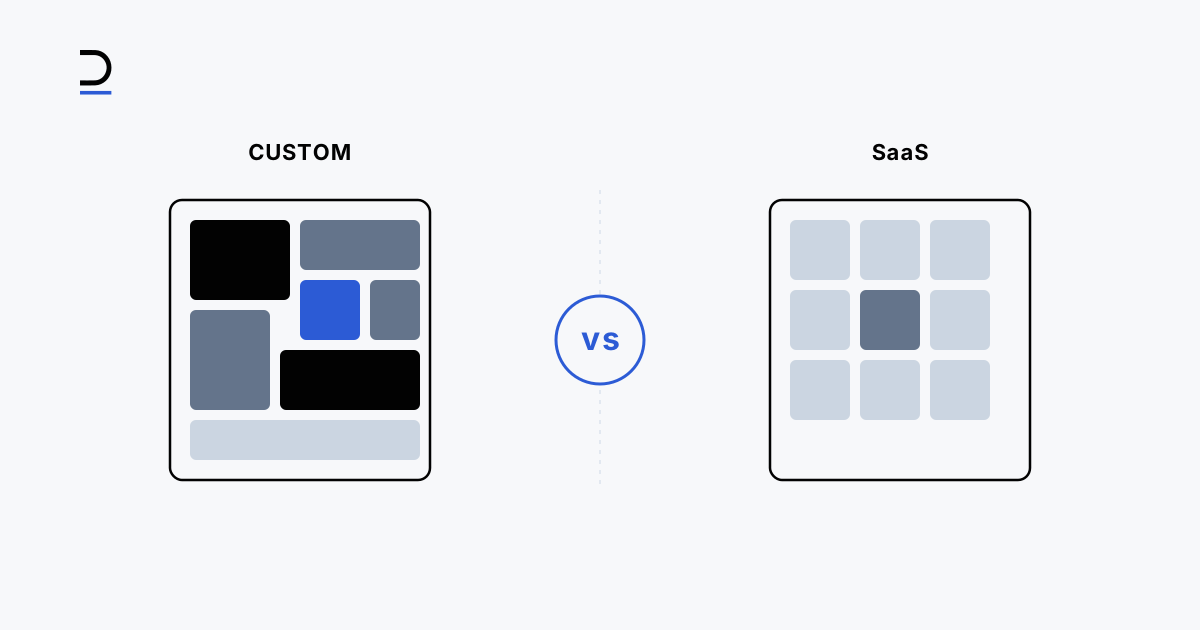
Custom software vs SaaS: how AI changed build-or-buy
Quick answer: AI-assisted development has compressed the time and cost of building custom software by roughly 40 to 60% on typical SME-scale projects. SaaS still wins for commodity needs and where the product genuinely fits, but the "rent rather than own" default is wrong more often than it used to be. The build-or-buy line has moved.
For the last decade we've built software for businesses that couldn't find a SaaS to fit. The decision to build instead of buy was rarely close. SaaS was cheap, fast, and scaled with your team. Custom was expensive, slow, and only justified when nothing off-the-shelf could do the job at all.
That's changed. In the last 18 months, AI-assisted development has compressed delivery time on typical SME-scale projects by roughly 40 to 60% in our experience. The dollar cost has dropped in step. Custom software that used to need a six-figure budget and nine months can now ship in three to five months for less. The buy-or-build line has moved, and most businesses are still making decisions on a 2022 mental model.
What is clear is that SaaS still wins a lot of the time. But the "rent rather than own" default is wrong more often than it used to be. Here's what's actually changed, where each side wins, and a simple framework for deciding which side of the line you're on.
The build-or-buy question wasn't this complicated five years ago
Five years ago, the build-or-buy decision for an Australian business with 30 to 200 staff usually went like this. You had a problem. You looked at SaaS options. If something fit reasonably well, you bought it. If nothing fit, you either suffered with the closest match, glued together two or three tools with Zapier, or asked someone to build a custom solution and then spent a year talking yourself out of it because the quote was $250,000 and the timeline was nine months.
The economics were straightforward. Salesforce or HubSpot at $150 per seat per month for ten staff costs $18,000 a year. A custom CRM with similar functionality cost $200,000 to build and another $30,000 a year to maintain. Even at a 10-year horizon, SaaS won easily on cash terms. So most businesses bought SaaS, even when SaaS didn't quite fit.
That math worked because building software was genuinely expensive. A team of three or four developers grinding through a custom build, six to twelve months of effort, plus design, project management, infrastructure setup, testing. The cost wasn't padding. It reflected the actual amount of human labour the work required.
What's changed is the labour part of that equation. AI-assisted development tooling, including GitHub Copilot, Cursor, Claude Code and Replit, has materially compressed the time required to ship working software. Not by a small amount. By close to half on typical SME-scale projects.
What AI-assisted development actually changed (and what it didn't)
The thing AI changed is the cost and time of producing the code itself. Engineers who used to spend a day writing a feature now spend half a day. Engineers who used to spend a week wiring up an integration now spend two days. The repeatable, well-understood parts of building software are dramatically faster, and that compounds over the course of a project.
The thing AI didn't change is the work that surrounds the code. Discovery and design, integration with messy legacy systems, user testing, deployment and operations, long-term maintenance. Those still require the same engineering judgement and operational discipline they always did.
This is the part that gets missed in the "AI builds your app for you" hype. AI shortens the build phase. It doesn't shorten the run phase. We've written about why most AI prototypes never make it to production for the detailed version, but the headline is that production software has a long list of non-obvious requirements (auth, observability, error handling, integrations, scale) that AI doesn't generate for you. Businesses that learn this the hard way are usually the ones that thought "AI built our app" was the whole story.
So the practical effect of AI on custom software economics is more nuanced than the marketing suggests. Build cost is down meaningfully. Operational and maintenance cost is roughly flat. The total cost of ownership over a 5-year window has dropped, but it hasn't collapsed.
For SME-scale projects, that's enough to change the decision. A custom build that used to be $250,000 and 9 months is now in the $30,000 to $200,000 range and 3 to 5 months. That's not a small move. Combined with SaaS subscription costs that have continued to creep up, it's enough to put a lot of buy-or-build decisions back into play.
Where does SaaS still win in 2026?
SaaS still wins three categories of need cleanly, and we'd recommend it without hesitation in each.
First, commodity functions where the work is genuinely the same across every business. Accounting, payroll, basic project management, email marketing, e-commerce checkout. Xero handles your books just fine. There is no advantage to building a custom general ledger and a long list of reasons not to.
Second, problems where the SaaS product genuinely fits how you operate. If Monday.com matches the way your team already works, if HubSpot does what your sales process needs, if Notion holds your knowledge base well, then the friction of building custom isn't justified. The test is whether you're shaping your operations to fit the tool, or the tool already fits how you operate. If the answer is the second one, buy SaaS.
Third, problems where the cost of getting it wrong is high and the SaaS provider has more domain expertise than you do. Identity management, payment processing, security infrastructure. We use AWS for our own platforms. We don't build identity providers from scratch.
In all three categories, the SaaS economics are still excellent. Pay your subscription, get on with running your business, redirect the engineering capacity that custom would have absorbed.
The places SaaS doesn't win as cleanly as it used to are the ones where it never quite fit but the build cost was prohibitive. That's the territory worth re-examining.
Where does custom software win now?
Custom software wins when at least one of three things is true. The SaaS landscape doesn't fit your specific operational pattern. The work has competitive value that you don't want to standardise on a generic tool. Or the subscription costs are high enough that the build economics flip.
The first is what we see most often. A business has built up a way of working over years that's genuinely specific to its market. A specialist trade contractor with a scheduling pattern that doesn't map to any generic field service tool. A professional services firm with a billing structure that no SaaS supports cleanly. A logistics operator with a routing problem that requires combining data from three telematics providers and a customer-managed depot system. None of these have a SaaS answer that fits, and the workarounds (Zapier integrations, manual reconciliation, two staff dedicated to keeping the spreadsheet up to date) usually cost more than the businesses realise.
The second is the one most boards underestimate. If a process is part of how you compete, doing it on a generic tool means doing it the same way as competitors who use the same tool. Custom software doesn't just give you software that fits; it gives you operational difference that's hard to replicate.
The third is just arithmetic. A team of 50 paying $200 per seat per month for a SaaS suite that doesn't quite fit is spending $120,000 a year. Over 5 years that's $600,000, before any per-seat scaling. A custom build sized for that team will cost $80,000 to $150,000 once. The math gets harder for SaaS as the seat count and feature set grow.
We've worked through this on our own platform. Our fleet intelligence product, Nuonic, has been in production since 2016, and over the last 18 months we've rebuilt several of its core components using AI-assisted development. The platform processes 18 million kilometres of vehicle activity per month and delivers a 264% ROI for operators. No SaaS does what Nuonic does, because the integration burden across 16 plus telematics providers makes it impractical to build for a generic market. When the work is specific enough, custom is the only option that fits, and the AI-era economics make both new builds and rebuilds easier to justify.
There's also a category we'd flag where the answer is custom even though many businesses default to SaaS. When the SaaS subscription is hiding manual work nobody is counting. We've described the symptoms of a business that's outgrown its tools elsewhere. If any of those apply, custom is probably worth pricing.
How do I decide whether to build custom or buy SaaS?
Here's a five-question test. Run it on a specific decision you've got in front of you.
1. Does the SaaS option you're considering actually fit how you work today, or are you planning to change your operations to match it?
If you're shaping your business to fit the tool, custom should be on the table. If the tool genuinely fits, buy SaaS.
2. Is this process part of how you compete, or is it a commodity function?
If it's commodity (accounting, generic CRM, payroll), buy SaaS. If it's part of your competitive difference, custom is worth pricing.
3. What's the 5-year subscription cost at your current scale, and what would it be at 2x scale?
Add it up honestly. Per-seat subscription stacks compound when you grow. If the 5-year number is approaching $200,000 or more, get a custom quote for comparison.
4. How much manual work, glue code, and human reconciliation does the SaaS option require to actually do the job?
Most SaaS comparisons assume the SaaS works out of the box. Most don't. The two staff who spend half their time keeping the SaaS aligned with your operations are part of the SaaS cost, even though they don't show up on the subscription invoice.
5. Do you have someone available to own the system long-term if you build it?
Custom software lives or dies on the run phase. If there's no one to own it, SaaS is the safer bet regardless of fit. We've written about how to think about building to own versus building to run for the longer version.
A business that answers "doesn't fit, competitive process, $200k+ subscription cost, lots of manual work, owner identified" should at least price custom. A business that answers "fits, commodity, low cost, low manual overhead, no owner" should stay on SaaS.
In our experience working with businesses across Australia from our base in Brisbane, the businesses that benefit most from custom software in the AI era aren't the ones with the most exotic requirements. They're the ones whose SaaS stack technically works but is quietly costing them more than they're tracking, in subscription fees, manual workarounds, and operational friction. Our outcome-based pricing model exists partly to make this comparison cleaner.
What to do next
The default "just buy SaaS" answer worked for the last decade because building was prohibitive for most SME-scale problems. That's not true in 2026. AI-assisted development has moved the line, and the businesses that haven't updated their mental model are over-renting on subscription stacks that don't quite fit.
The next time you're about to renew a SaaS subscription that doesn't quite fit your business, take an hour to price the custom alternative honestly. The numbers might surprise you.
If you've got a specific decision in front of you and you want to test the build-or-buy math against current numbers, that's exactly what our Discover phase is for. Two to four weeks, prioritised, costed, no strategy decks. Start a conversation.
Frequently asked questions
How much does it cost to build custom software in 2026?
For SME-scale projects, $30,000 to $200,000 is the typical range, depending on scope and integrations. AI-assisted development has compressed this from the $100,000 to $400,000 range that was typical five years ago. The cost varies most with how many existing systems you need to integrate with and how many users the software needs to support. We've written about what custom software actually costs in 2026 for the detailed breakdown.
Isn't it always cheaper to use SaaS?
Often, but not as often as it used to be. SaaS pricing has crept up while custom build costs have come down. For commodity functions like accounting or basic CRM, SaaS still wins easily. For specific operational patterns where the SaaS doesn't quite fit, the math at 5-year horizons is now closer than most businesses realise, and the manual workaround cost on poorly fitting SaaS often tips the balance.
Can AI-built software actually replace a SaaS product?
Yes, when the use case is well-defined and the business has someone to own and maintain it. AI-assisted development is genuinely good at producing the code; it doesn't change the operational discipline required to keep production software running. Most "AI built our app" failure stories are really "we didn't budget for the run phase" failures.
How long does custom software take to build now?
A typical SME-scale project that would have taken 9 to 12 months in 2022 now ships in 3 to 5 months. Larger or integration-heavy builds can still take longer. The biggest factor is usually the design and discovery phase, since AI hasn't changed how long it takes to figure out what to build.