How to deploy AI agents without losing control
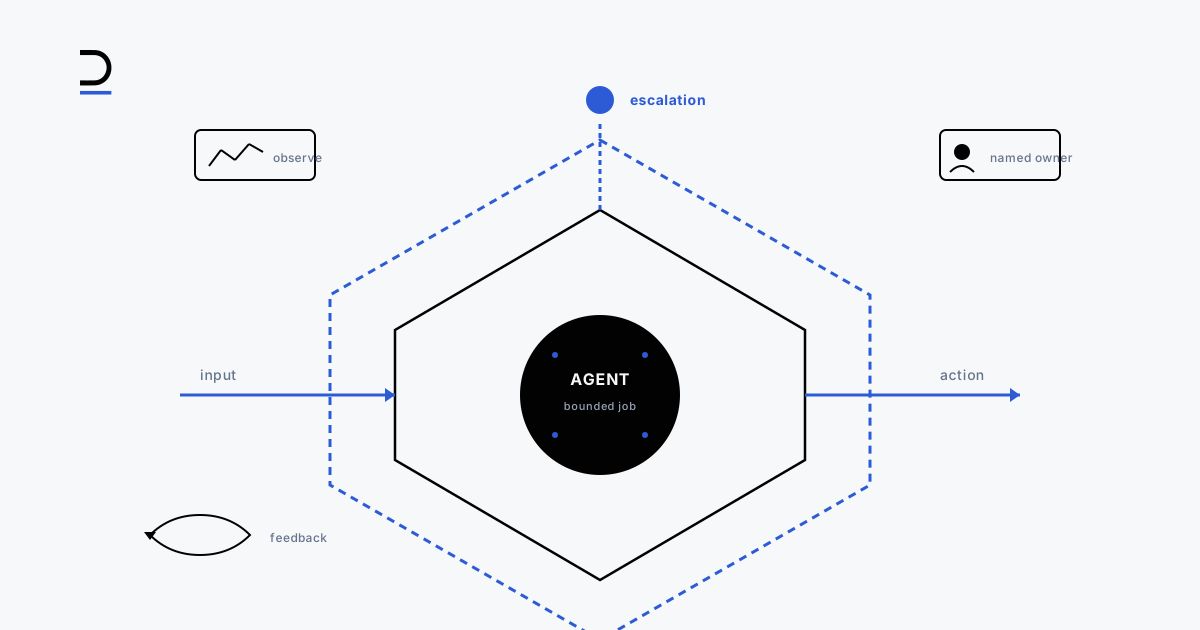
Quick answer: Five operational disciplines separate AI agent deployments that work from ones that fail: a bounded job, hard guardrails with escalation paths, observability from day one, a named owner with authority, and a feedback loop. Get these right and the agent runs reliably. Get them wrong and it eventually does something embarrassing, expensive, or both.
"AI agent" has become one of those phrases that means everything and nothing in 2026. Every SaaS product ships them. Every consultancy offers them. Most of what's actually being deployed isn't an agent in any operationally meaningful sense; it's a chatbot with a slightly broader prompt.
But genuine agents, software that takes actions on real systems based on AI decisions, are starting to show up in production at SME scale. The deployments that work share a small set of operational disciplines that the deployments that don't, miss. The disciplines aren't technical. They're operational. Get them right and the agent runs reliably. Get them wrong and it eventually does something embarrassing, expensive, or both.
The high-profile failures so far teach roughly the same lesson. Air Canada was held legally liable when its support chatbot invented a refund policy. Klarna walked back its all-in customer-service-AI deployment and rehired humans after the customer experience deteriorated. Several Australian pilot rollbacks have followed similar patterns. The technology mostly works. The deployments mostly don't, because the operational discipline around them is missing.
Here's the playbook we'd use, and the five disciplines that separate working agent deployments from runaway ones.
What does it mean to deploy an AI agent?
Before the disciplines, a quick definition because the term has been so abused. An AI agent, for the purposes of this article, is software that takes actions on real systems based on AI decisions. Not just generates text. A chatbot that answers questions is not an agent. A workflow that classifies a document and routes it to the right team based on AI classification is. A system that decides whether to approve a leave request, escalate a complaint, or trigger a compliance check is.
The distinguishing feature is action on real systems. Once an AI is making decisions that flow into business systems (CRM, ticketing, scheduling, financial systems), the failure modes change. A chatbot that gives a wrong answer is annoying. An agent that takes a wrong action can refund money it shouldn't have, send a customer to the wrong escalation path, miss a regulatory deadline, or update a record that fifty other workflows depend on.
This distinction matters because the disciplines below are designed for the action-taking version. We've covered what AI agents can and can't do well in 2026 for the realistic-expectations side. This article assumes you've decided to deploy and want to do it without losing control.
What are the five disciplines for deploying AI agents safely?
The disciplines below are the ones we'd put non-negotiably in place for any agent that takes real action in production. They're easier to apply when you start fresh than when you retrofit, so use them as a deployment checklist rather than a recovery plan.
1. Bounded job.
The single most important thing you can do for an agent deployment is define the bounded job clearly. Not a domain ("customer support") but a specific task with defined inputs and outputs ("classify incoming customer support emails by intent and route to the right team's queue").
This sounds obvious and is the most common cause of agent failure we see in the work. Founders and ops leaders define agents in terms of outcomes ("handle customer support") rather than tasks ("triage incoming tickets into one of four categories"). The result is an agent with permission to take any action that might plausibly relate to customer support, and no clear way to tell when it's operating outside its purpose.
The Air Canada chatbot is a clean example of unbounded scope. It was given conversational latitude wide enough that it could (and did) invent refund policies that didn't exist. A bounded version of the same agent, one whose only output was "show this customer one of these eight pre-approved policy explanations", couldn't have made the mistake.
The test for whether you've bounded your agent's job well is simple. Write down what the agent does in one sentence. If you can't, the job isn't bounded enough.
2. Guardrails and escalation paths.
Once the job is bounded, define what happens at the edges. What does the agent do when it doesn't know? When the input doesn't fit the patterns it was designed for? When the action it would take falls outside the rules? When the cost of being wrong is high?
Two specific patterns to build in. Hard guardrails (rules the agent cannot break, regardless of model behaviour) and graceful escalation (a defined path to a human when the agent is uncertain or hits a guardrail). Both are easy to talk about and surprisingly hard to implement well.
A common mistake is building guardrails as soft prompts ("don't do X") rather than as system-level enforcement. Soft guardrails fail because LLMs don't reliably follow instructions that conflict with what the user is asking. Real guardrails are implemented in the surrounding code, not in the prompt. If the action is "issue a refund", the surrounding system checks the refund amount against a hard limit before the agent ever gets to decide; the agent doesn't get to authorise its own $10,000 refund.
Escalation paths are the equivalent for uncertainty. A well-designed agent knows when it doesn't know and routes to a human. A badly-designed one makes something up rather than escalating, which is exactly what produced the Air Canada policy hallucination.
3. Observability from day one.
You can't control what you can't see. Observability for agents has three layers. Every action the agent takes (what it did, when, on whose request). Every decision the agent made (the input, the model output, the reasoning where available). And every cost the agent incurred (LLM API calls to OpenAI, Anthropic, or Google, downstream system calls, wall-clock time taken).
Most agent failures are visible in the data well before they're visible in the business consequences. An agent drifting toward making more wrong decisions usually shows it in confidence patterns or unusual reasoning first. The problem is that without observability built in from the start, nobody is looking at this data. Build the observability before you launch, not after the first incident. Retrofitting observability after the fact is expensive and usually incomplete. We've covered why most AI prototypes never make it to production for the broader version of this point.
4. Named owner with authority.
The agent needs an owner. Not a committee. Not "the technology team". A specific named person whose job includes monitoring the agent's behaviour and making decisions about when to change it, throttle it, or retire it.
The owner needs three things. Visibility (the observability described above). Authority (the ability to actually change the agent's behaviour without a six-week change-management cycle). And time (this can't be a side project for someone already running the operation the agent supports).
Klarna's customer-service-AI walkback is partly a story about ownership. They deployed widely, didn't have someone whose full-time job was to monitor performance against real customer outcomes, and only saw the customer-experience consequences after they were significant enough to require a public reversal. In our experience, the deployments we've observed locally that work always have a named owner with authority. The ones that struggle usually don't.
5. Feedback loop.
Agents don't get better on their own. Without a feedback loop, the same mistakes repeat indefinitely. With one, the agent's performance improves as the business learns from how it operates in production.
A feedback loop has three components. Capture (when the agent does something right or wrong, that signal gets recorded against the action). Review (someone or something looks at the captured signal regularly). And incorporation (the learning gets fed back into the agent's prompts, guardrails, training data, or escalation rules).
The most common pattern we see in struggling deployments: the capture step exists but nobody reviews the captured data, and the incorporation step never happens. Without all three, the loop is broken. We've written about why AI agents underperform and how to fix it for the diagnostic version. This connects directly back to the named-owner discipline. The owner is the person who runs the feedback loop.
How do I deploy my first AI agent in 90 days?
The disciplines above are easier to apply when you start fresh than when you retrofit. Here's a 90-day deployment sequence we'd suggest for a first agent. We've covered choosing the right first use case in detail; this section assumes the use case is selected.
Days 1 to 30: define and design.
Write down what success looks like in measurable terms. Define the bounded job in one sentence. Specify the guardrails and escalation paths. Spec the observability you'll need (every action, every decision, every cost). Identify the named owner and confirm they have the authority and the time. Choose the foundation model (OpenAI, Anthropic, or Google) and the surrounding infrastructure. The output of this month is a design document, not running software.
Days 31 to 60: build and run in shadow mode.
Build the agent. Run it in shadow mode in production: it makes decisions but doesn't act on them. Capture every decision and compare against what a human would have done in the same situation. Tune the agent until its decisions match human judgement at acceptable accuracy. Shadow mode is the cheapest insurance against the public-failure scenarios. It costs you a month of operational time and saves you from the consequences of an agent that wasn't ready.
Days 61 to 90: run live in narrow scope.
Switch the agent on for live actions, but in a narrow scope (one team, one department, one customer segment). Monitor closely. The owner reviews every action daily for the first two weeks, then weekly. Refine guardrails and escalation paths based on what you observe. Build the feedback loop into the operational rhythm.
After 90 days, if the agent is performing well, you have evidence to expand its scope. If it isn't, you have evidence to throttle, retire, or rebuild it. Either is a good outcome compared to the alternative of deploying widely on day one and discovering problems through customer complaints.
The fastest mistake we see is skipping shadow mode. It feels slow when the urge is to launch. It saves you from being the next Air Canada.
What to do when (not if) something goes wrong
Agents will eventually do something wrong. The question isn't whether but when, and the difference between a contained incident and a public crisis is how quickly you find out and how prepared you are to respond.
The contained-incident pattern looks like this. Observability flags an unusual action. The named owner reviews it within hours. The agent is throttled or paused while the issue is investigated. The underlying cause is fed back into guardrails or escalation rules. The agent resumes operation with the issue addressed. The customer who was affected gets a corrected outcome. Nobody outside the business needs to know it happened.
The public-crisis pattern looks like this. Nobody is watching the agent's behaviour. The agent compounds the same mistake across many customer interactions before anyone notices. The response is reactive and public rather than proactive and internal. By the time the business pauses the agent, customers have already noticed, journalists may have noticed, and regulators may have noticed.
The first pattern requires the disciplines above. The second pattern is what happens when they're missing.
For any agent in production, define your incident response upfront. Who gets notified when observability flags something unusual? What's the threshold for pausing the agent automatically versus reviewing first? Who has the authority to make the pause call? What's the customer-facing communication plan if it does become public? Australian law has been clarified on this point: businesses are responsible for their agents' actions, including incorrect ones. The Air Canada case in Canada established the same principle. Plan accordingly. This is fifteen minutes of planning that you'll be very glad you did.
Where this leaves you
Most businesses that deploy AI agents successfully in the next two years won't be doing anything technically novel. They'll be applying these five disciplines properly while everyone else is chasing model releases. The technology has gotten good enough that the differentiator is operational discipline, not capability.
In our experience working with businesses across Australia from our base in Brisbane, the agent deployments that work are the ones where the operators treated the disciplines above as non-negotiable from day one. The ones that don't are the ones where the disciplines were added after the first incident.
If you've got a specific agent deployment in mind and you want to test the design against the disciplines above before you commit to it, that's exactly what our Discover phase is for. Two to four weeks, prioritised, costed, no strategy decks. Start a conversation.
Frequently asked questions
What's the difference between an AI agent and a chatbot?
An agent takes actions on real systems based on AI decisions. A chatbot generates text in response to user input. The distinction matters because the failure modes are different: a chatbot that gives a wrong answer is annoying, but an agent that takes a wrong action can have downstream consequences across customer relationships, financial systems, or compliance obligations.
How much does it cost to run an AI agent in production?
LLM API costs are the most under-estimated part of agent operations. A modest-volume agent (around 1,000 actions per day) typically costs $200 to $1,500 per month in API calls alone, depending on the model and the complexity of the task. Add infrastructure, observability, and the named owner's time, and ongoing operating cost for a single production agent is usually in the $2,000 to $5,000 per month range.
Can a small business actually deploy AI agents responsibly?
Yes, but only with all five disciplines in place. The disciplines scale down to small business contexts well; a bounded job, guardrails, observability, named owner, and feedback loop don't require enterprise infrastructure. What they do require is operational discipline and someone with the time to apply it. Without that, small businesses are at higher risk than larger ones, because they have less margin for absorbing a public failure.
What happens if the agent makes a wrong decision that affects a customer?
Australian law has been clarified on this point: the business is responsible for the agent's actions, including incorrect ones. The Air Canada case in Canada established the same principle. This means an agent that hallucinates a policy, makes a wrong financial decision, or misroutes a customer issue is your problem, not the AI vendor's. Plan for this in your incident response, your guardrails, and your customer communication strategy.