What "AI-native" actually means for your business operations
Quick answer: AI-native means your business has redesigned at least one core operational process around what AI can do, with a production AI system running in that process and a named owner keeping it working. It's a structural change, not a tooling layer. Most businesses claiming the label are AI-enabled, which is a different and earlier state.
"AI-native" is the most over-used and least-defined phrase in business technology right now. Sit in any operations meeting in 2026 and you'll hear it at least once. Companies are claiming it on their websites, leaders are using it in board updates, and consultants are selling it back to anyone who'll buy. Most of the businesses claiming the label haven't earned it.
That's the problem. The term is doing real work for the small number of businesses that have crossed the line, and real damage when used by everyone else. Without a definition that holds up, "AI-native" becomes another piece of buzzword inflation.
So here's our attempt to pin it down. What "AI-native" actually means, the four states a business can be in on its way there, five questions to honestly assess where you sit, and what crossing the line takes.
Why "AI-native" needs a definition
When a phrase like "AI-native" gains traction without a clear definition, it's usually because the underlying idea is shifting under everyone's feet. That's true here. The capabilities of foundation models from OpenAI, Anthropic, and Google have changed what's possible inside an operating business in the last 18 months, and the language hasn't caught up.
But the term has also been swallowed by marketing. A business that has rolled out Microsoft Copilot to its staff is now "AI-native". A business that has added a chat widget to its website is "AI-native". A business that uses ChatGPT to write its emails is "AI-native". The bar has been set so low that the label tells you almost nothing about what's actually happening inside the business.
This matters for two reasons. First, the businesses that are genuinely AI-native are pulling ahead in measurable ways (decision speed, cost-to-serve, capacity per head), and lumping them in with everyone using a copilot loses the distinction. Second, leaders inside businesses can't honestly assess where they sit if the term doesn't draw a line in a useful place.
So we need a definition that does work. One that distinguishes between "we use AI" and "we are AI-native", and that gives the reader a way to locate themselves on the path.
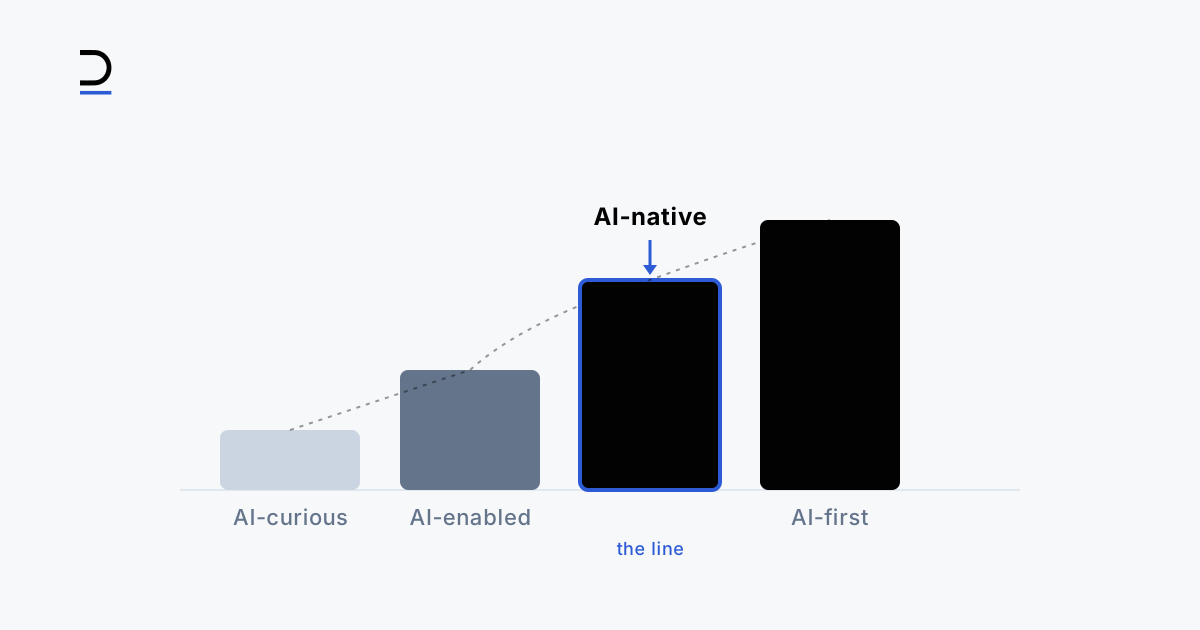
What are the four states of AI maturity?
There are four reasonable states a business can be in. They're not perfectly clean (real businesses sit between two of them most of the time), but they're useful for orientation.
1. AI-curious
The business is paying attention. Leadership has read the articles, attended the conferences, talked to peers. Some staff are using ChatGPT or Claude on their own initiative. There's no formal AI strategy and no AI deployments inside the operating business itself, but there's awareness and interest.
This is where most Australian SMEs actually sat at the start of 2025. A surprising number are still here.
2. AI-enabled
The business has deployed AI features into its existing operations. Microsoft 365 Copilot is rolled out across the team. The CRM has its AI features turned on. Marketing uses Notion AI for drafting and Zapier for AI-flavoured automations. There's a written AI policy. Maybe one or two specific workflows have been augmented with off-the-shelf AI tools.
This is genuine progress. It produces real productivity gains and gives staff hands-on familiarity with the tools. But the business itself, how it's structured, what it does, how decisions get made, looks fundamentally the same as it did before. AI is a layer over existing operations, not a redesign of them.
3. AI-native
This is the line. AI-native means the business has redesigned at least one core operational process around what AI can do, rather than bolting AI onto a process designed for humans. The work moves through the business differently because of AI. Decisions that previously required senior judgement are now triaged, scored, or pre-decided by AI before a human reviews them. Functions that previously required headcount are now run by software, often AI agents taking real action in operations, with humans on exception handling. Data flows that previously needed manual reconciliation now reconcile themselves.
Crucially, the business has built or adopted operational AI systems that work in the messy, imperfect environment it actually competes in. Not demos. Not prototypes. Production systems with the error handling, observability, and integrations to keep running when something goes wrong. There's a huge difference between an instant AI-generated app and a system that's fit for purpose in real operations, and AI-native businesses have crossed that gap.
4. AI-first
The business doesn't just operate with AI inside its core processes. It was conceived to operate that way from day one. Most of the AI-first businesses that exist today are 2024-onwards startups. A small number of established businesses are also genuinely AI-first now, having rebuilt themselves around AI capability rather than retrofitting it.
For the 30 to 200 staff established business, AI-first is rarely the realistic target in the next three years. AI-native is.
How do I tell where my business actually sits?
Run these honestly. The answers will locate you in one of the four states. If you find yourself reaching for caveats, you're probably in the lower state, not the higher one.
1. Has at least one of your core operational processes been redesigned because of what AI can do, not just augmented with an AI feature?
Redesigned means the steps, the people involved, the timing, or the inputs and outputs are now different. Augmented means the steps are the same but one of them is now done with AI assistance. If the answer is "no genuine redesign yet", you're AI-enabled.
2. Is there a production AI system in your business that's been running for more than three months, with monitoring, error handling, and a person responsible for it?
Production means real workload, real users, real consequences when it breaks. A POC that's been running in someone's browser for three months doesn't count. Our own fleet intelligence platform Nuonic processes 18 million kilometres of vehicle activity each month and delivers a 264% ROI for operators on fuel tax credits and productivity. That's the operational discipline an AI-native production system runs on. If you can't name your equivalent system and the person responsible for it, you're AI-enabled.
3. Has at least one role or function in your business changed in shape, scope, or headcount because of AI?
Not been replaced (that's a different question). Changed shape. The work the role does is different now, the volume one person can handle is different, the type of decisions that role makes is different. If everyone's doing the same job they did 12 months ago, just a bit faster, you're AI-enabled.
4. Can your business answer "what would we do differently if AI got 30% better in the next 12 months?" with something specific?
AI-native businesses are organised around AI as a moving target. They have a view of what improves when AI gets better, and they're set up to capture that improvement quickly. AI-enabled businesses don't usually know yet, because their operating model isn't sensitive to it.
5. Does your data flow into systems that AI can use, in something close to real time?
Most AI projects fail on data, not on AI. If your operational data is locked in spreadsheets, in disconnected SaaS tools, or in formats that need manual reconciliation, your business has a structural ceiling on how AI-native it can become. The unsexy infrastructure work is what makes the difference.
A business that answers "yes" to all five is AI-native. A business that answers "yes" to one or two is AI-enabled with ambition. A business that answers "no" to all five is AI-curious, regardless of what its website says.
In our experience, fewer than one in ten of the businesses we've observed locally (we're based in Brisbane and work with companies across Australia) have crossed this line. That's not a criticism. It's a reflection of how recently the underlying capability has been good enough to redesign around, and how much of the work that crossing requires is operational rather than technological.
What does it take to become AI-native?
Crossing from AI-enabled to AI-native isn't a tooling problem. It's an operational one. The businesses that have done it well share a few patterns.
They've picked one or two operational processes to redesign first, rather than trying to make everything AI-native at once. The first process is usually a high-volume, repetitive one with clear right and wrong answers (document classification, customer triage, scheduling, reporting). It's chosen because it's a good fit for AI, not because it's the most strategic process in the business.
They've invested in the unsexy infrastructure that makes AI useful: data integration, system connectivity, real-time data flows, observability. This is the part most businesses underestimate, and without it the AI sits on a foundation that won't hold up.
They've moved at least one prototype from "this works on my machine" to "this works in production". This is a much bigger jump than it sounds. Most of what needs to happen between a working prototype and an operational system is invisible from the outside (auth, logging, error handling, integrations, drift management, scale), but it's where the real work is. We've written about why most AI prototypes never make it to production for anyone watching this happen inside their own business.
They've made it someone's job to keep the AI working. Not a side project. Not a committee. A named person, with the authority and the time to monitor, adjust, and improve the system over time. AI doesn't run itself. It runs as well as the operational discipline you put around it.
And they've started thinking about software differently. Less as a fixed asset that gets bought and installed, more as a capability that gets built and maintained.
If this sounds like a lot of work, it is. But it's also tractable. Most of the businesses we've worked with that have crossed the AI-native line did so within 12 months of deciding to. We've described the 12-month operating plan we use in another piece for anyone wanting more detail.
Why this is worth getting honest about now
Most businesses don't need to be AI-native this year. AI-enabled is enough, for now, to capture the productivity gains the current tooling offers without redesigning anything. For a lot of 30 to 200 staff businesses, that's a defensible position.
But the gap is widening. Businesses that have crossed the AI-native line are pulling ahead on measurable things: cost-to-serve, decision speed, capacity per head, ability to take on more complex work without proportionally more cost. Those gaps compound. A business that gets to AI-native in 2026 has a roughly two-year head-start on a business that gets there in 2028, and that's hard to close.
The risk isn't being late by a year. The risk is being late by a year and not knowing it, because you've been calling yourself AI-native the whole time without checking. The five questions above are uncomfortable on purpose. They're designed to surface what state you're actually in, not the one your website claims.
What is clear is that this is a measurable, locatable problem. Either your business has redesigned something around AI or it hasn't. Either there's a production AI system with someone responsible for it, or there isn't. The honest assessment is the first move.
If you want help working out where your business actually sits, that's exactly what our Discover phase is for. Two to four weeks, prioritised, costed, no strategy decks. Start a conversation.
Frequently asked questions
Is AI-native the same as AI-first?
No. AI-first describes a business conceived to operate around AI from day one, typically a 2024-onwards startup or a fully rebuilt established business. AI-native describes a business that has redesigned at least one core operational process around AI but didn't start out that way. For most established businesses with 30 to 200 staff, AI-native is the realistic and useful target.
Does my business need to be AI-native to compete?
Not in 2026, for most industries. AI-enabled is enough to capture the productivity gains current tooling offers. But the gap between AI-native and AI-enabled businesses is widening on measurable things like cost-to-serve and capacity per head, and that gap compounds over time. The honest question is when, not whether, your business will need to cross the line.
What's the difference between AI-enabled and AI-native?
AI-enabled means AI features have been added to existing processes (Microsoft Copilot rolled out, CRM AI features turned on, an AI policy in place). AI-native means at least one core operational process has been redesigned because of what AI can do, with a production AI system running in that process and someone responsible for keeping it working. The difference is whether the business looks structurally different because of AI, or just runs the same operations a bit faster.
How long does it take a 30 to 200 staff business to become AI-native?
In our experience, businesses that genuinely commit to crossing the line do so within 12 months. The work is mostly operational rather than technological: picking the right first process, investing in data integration, deploying a production-grade system, and building the operational discipline to keep it running. Businesses that short-cut the operational work usually end up back at AI-enabled within 18 months.